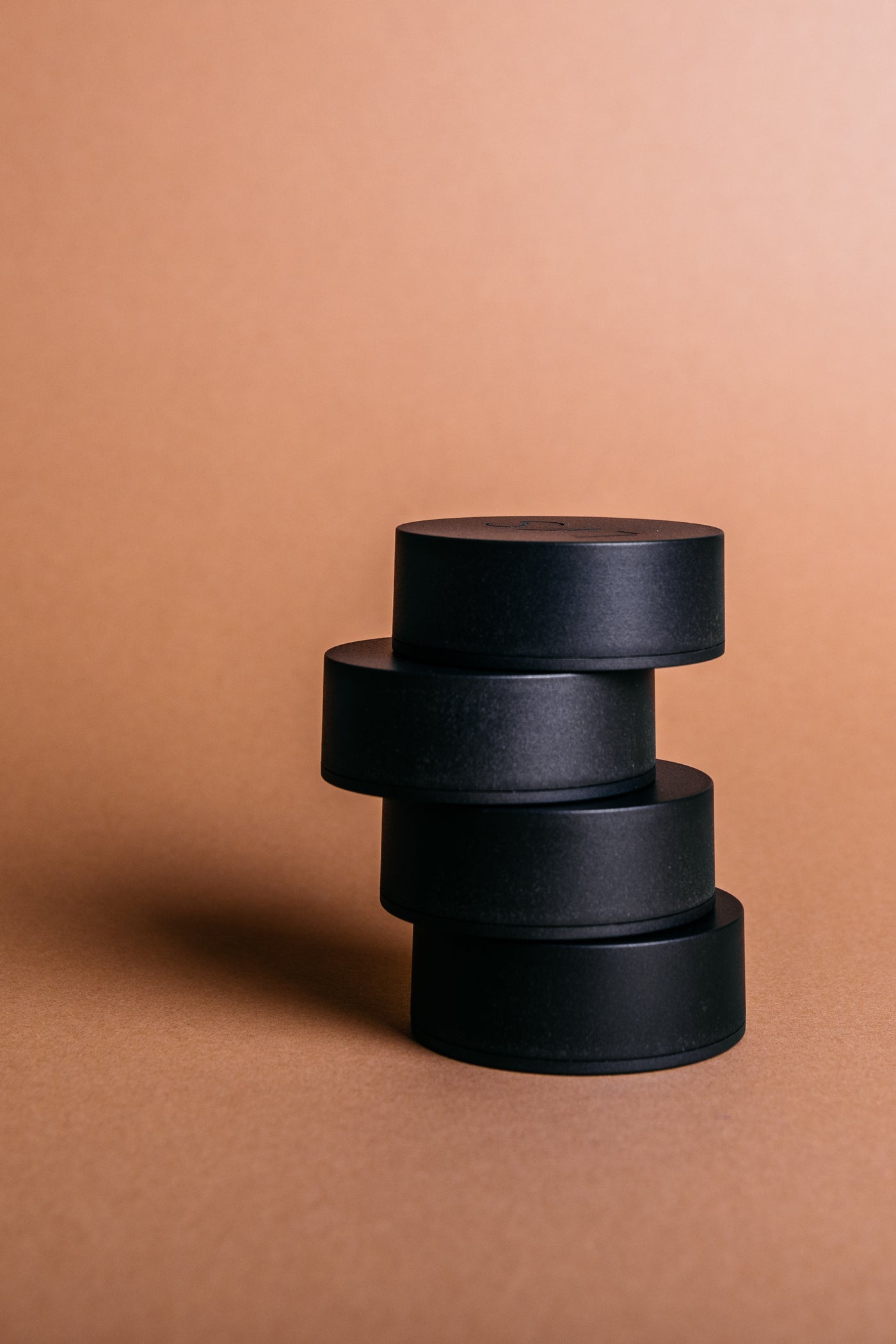
LYS sensor, field-tested at night: real product photography
Our story
Six steps from a question to LYS
As told by Christina Friis Blach, co-founder
Imperial & RCA IDE research: light responding to a wearer, not a roomWhere every idea starts: a wall of references, not a briefThe first prototype: electrochromic glasses for the night shiftThe personal light installation: light that responds to the personIDE research: worn before it was wearableTwo of the first working units, side by side, still slightly mismatched
THE QUESTION
It started under fluorescent lights
Working late at Imperial College London and the Royal College of Art on an Intel brief about modern urban life, I sat beneath rows of fluorescent tubes: bright, static and blind to the time of day.
We spend most of our lives under artificial light, yet rarely treat it as part of our health the way we treat sleep, movement or nutrition.
THE DISCOVERY
Important knowledge, hidden in plain sight
The work of Professor Russell Foster and other scientists showed that the timing, intensity and spectrum of light shape our body clocks, sleep and health.
The science existed, but mostly inside academia, and rarely outside controlled lab conditions.
The question was how to bring it into everyday life.
FIRST EXPERIMENT
A pair of glasses for the night shift
Our first concept was a pair of electrochromic glasses for nurses on night shifts, with lenses that changed during the shift.
Instead of asking the body to adapt to static lighting, what if light adapted to the person?
Light should be connected to people, not only to rooms.
PERSONAL LIGHT
Imagining light that knows who it is for
An art and technology installation imagined a future in which light is connected to the individual and changes as their needs change through the day.
It also revealed the core challenge: before light can respond, it has to understand what a person is actually experiencing.
THE SENSOR
To change light, we first had to measure it
People don’t stay at fixed points in a room. Through Imperial College London’s Althea programme, the first wearable LYS sensor took shape.
It captures personal light exposure over time: for researchers, for designers, and as feedback for lighting that responds.
The sensor made an invisible part of the day visible.
BECOMING LYS
Taking the idea into the real world
In 2016 we launched the sensor on Kickstarter, and the project became LYS.
Since then, LYS sensors have supported research in more than 55 countries: in homes, workplaces, hospitals and field studies.
What happens when light becomes connected to the person, not only the space?
The founders
Two disciplines. One persistent question
Christina and Hugo turned an early exploration of personal light into wearable technology used by researchers around the world, combining human-centred design, biomedical engineering and healthcare.
Today LYS is a small, hands-on team working across hardware, software, design and research, guided by an independent Scientific Advisory Board.
Works across design, technology and human experience. Her research into how light shapes our days formed the foundation for LYS.
CO-FOUNDER
Hugo Starrsjo
Biomedical engineering and healthcare
Connects the LYS vision with research, healthcare and the practical demands of real-world measurement.
Our mission
Make healthy light available to everyone
Light is fundamental to life, yet one of the least understood parts of our daily environment. We build the tools to understand personal light, connecting established science with real-world data and bringing researchers, designers, architects and technologists into the same conversation.
It is about creating light that understands people.
01
Based on science
We start from evidence and stay curious about what we don’t yet know, moving light science beyond academic walls.
02
Powered by people
There is no single ideal light for every person and moment. We focus on how people actually live, work and rest.
03
Enabled by technology
We make the invisible measurable, so light can be studied and acted upon.
Why personal light matters
One question, many disciplines
Wearable measurement takes light research beyond the laboratory, connecting controlled science with the light people experience in everyday life.
A space can meet every lighting requirement and still feel very different to the people in it. Personal measurement shows how its light is actually experienced over time.
Light surrounds us from waking to sleep, yet most of us know very little about our own exposure. Making it visible is a new way to understand our bodies and the spaces we live in.
We are interested in the questions that emerge when light science meets real life. Whether you are investigating light and health, designing the spaces where people live and work, or developing technology that could make environments more responsive, we would like to hear what you are exploring.